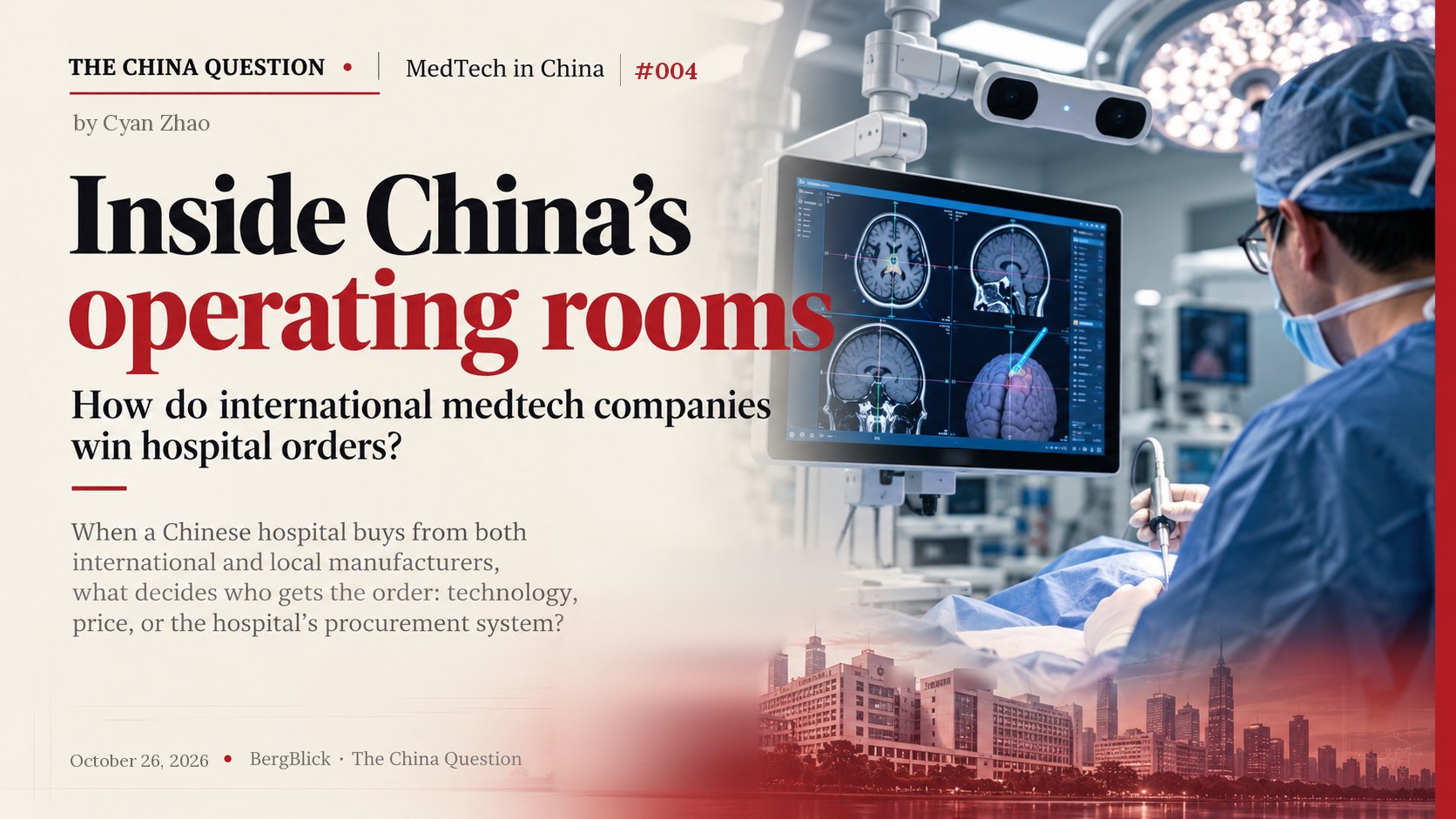
Editor’s note: from retail shelves to the operating room
From 16 to 19 November 2026, MEDICA, one of the most important events in the global healthcare industry, opens in Düsseldorf. Every year, medtech manufacturers, industry experts and business leaders from around the world gather here to show new products, find partners and discuss where the industry is heading.
With MEDICA approaching, The China Question is starting a new research series: MedTech in China. In earlier issues, I focused on China’s retail and consumer goods market: how international brands enter China, how they build sales channels, and why sales growth doesn’t always mean profit growth. This time, we move from the retail shelf to the hospital operating room.
For me, this is not an entirely unfamiliar step. Before moving into retail, I spent several years as a medical representative with Eli Lilly and Boehringer Ingelheim in Shanghai, working with physicians and hospital departments every day. Later, I helped a Chinese retail company expand nationwide. Both experiences left me with the same question: how does a product’s technological or brand advantage actually turn into real orders?
Recently, I have been exploring a career opportunity connected to an international medical technology company. It brought me back to a field that is both familiar and very changed. To understand China’s market for high-end medical equipment more deeply, I didn’t stop at company profiles and product brochures. I went back to primary public sources: government procurement files, tender specifications, award results and policy texts.
The deeper I went, the clearer it became that how Chinese hospitals choose this kind of equipment is far more complex than a simple contest of brand and price. So I decided to turn this research into the first article of The China Question’s MedTech series.
Let’s start with a concrete case: when Chinese hospitals already have local options, why do international manufacturers of high-end equipment still win orders?
1. One hospital, three manufacturers
In 2025, the First Affiliated Hospital of Zhengzhou University launched a tender for neurosurgical robots and navigation systems, with a total budget of RMB 20.8 million. Instead of buying one standard navigation system, the hospital split the project into four lots: a neurosurgical robot, an electromagnetic navigation system, an optical navigation system, and a combined optical–electromagnetic navigation system.
The robot lot was not awarded. The three navigation lots were awarded for a combined RMB 11.86 million. Public contract information shows that each of three brands was selected for a different lot: Medtronic from the US, Sinovation (华科精准) from China, and Brainlab from Germany.
| Category | Brand and model | Quantity | Contract value |
|---|---|---|---|
| Electromagnetic navigation | Medtronic S8 Cranial | 1 system | RMB 1.58 million |
| Optical navigation | Sinovation NS1-N | 2 systems | RMB 2.30 million |
| Combined optical–electromagnetic navigation | Brainlab Kick2 | 3 systems | RMB 7.98 million |
Source: Henan Government Procurement Network and public contract information. The lots differ in technical specifications and configuration, so contract values are not a direct price comparison between equivalent devices.
When I first read the award results, what caught my attention was not the prices. It was how the tender was split. One hospital, one procurement project, three categories of navigation systems built on different tracking principles, awarded to an American, a Chinese and a German company.
Because each lot had different technical requirements, the per-system prices cannot be compared directly, and they don’t prove that anyone earned a “brand premium”. But the case does show that, at least in this hospital, imported and local products were not locked in a zero-sum fight. Different technical solutions each had their place. Which leads to the question this article tries to answer: how does a hospital actually make this choice?
2. Local technology is changing the rules
For a long time, international medtech companies dominated China’s high-end equipment market on the strength of their R&D, clinical experience and mature product portfolios. That picture is changing.
The neighbouring field of surgical robotics shows how fast. According to public tender data, Chinese brands accounted for about 93% of the orthopaedic surgical robots (by number of systems) awarded in public hospital tenders in the first half of 2026. In laparoscopic surgical robots, the domestic share of awarded systems rose from 38% a year earlier to 63%. To be clear, orthopaedic robots, laparoscopic robots and neurosurgical navigation are different product categories. These numbers show a competitive trend in adjacent fields; they do not prove that the same shift has happened in neurosurgical navigation.
In navigation itself, the gap in features is narrowing. Sinovation’s public product materials describe multimodal fusion of CT and MRI images, 3D reconstruction, pre-operative path planning and optical tracking. Other Chinese companies, such as Fudan Digital Medical, also have neurosurgical navigation product lines. For international companies, “we have navigation” is no longer an advantage on its own.
But similar feature lists don’t mean similar clinical performance. For routine procedures, reliable basic navigation may be enough. In complex cranial surgery, surgeons care more about intra-operative image updates, functional imaging, instrument tracking, and how well navigation works with the surgical microscope and other equipment. So “imported or domestic” doesn’t explain much. The more useful question is: which solution fits this hospital’s actual clinical needs?
3. Why would a hospital pay different prices for different navigation systems?
The original tender documents from Zhengzhou offer a useful window. The optical navigation lot required infrared optical tracking, multimodal image fusion, support for DTI and BOLD imaging data, and an evaluation of registration accuracy. The combined lot required one system to offer both optical and electromagnetic tracking, with instrument registration, navigation and path planning for specific surgical scenarios.
The requirements differ a lot, and they probably reflect different clinical workflows. Of course, the tender documents alone can’t tell us the hospital’s internal reasoning behind each requirement.
What interested me more were the terms beyond the price. The tender required a five-year warranty, awarded extra points for each additional year, and asked suppliers to quote unit prices for the spare parts needed to keep the equipment running for ten years. Installation, training, response time, maintenance and delivery capability were all part of the evaluation. In other words, the hospital was not just buying a machine. It was buying the assurance that the machine would keep running for the next five years, that surgeons would know how to use it, and that someone would fix it when it broke.
For international companies, this is both an opportunity and a test. A strong local service network can be a real competitive advantage, but only if it shows up as verifiable commitments and evidence in the bid, not just in brand messaging.
4. Chinese hospitals don’t just pick the lowest bid
Many international companies that don’t know Chinese medical procurement well assume that public hospitals simply choose the cheapest offer. Reality is more complicated. The Zhengzhou tender used a comprehensive scoring method out of 100 points:
| Evaluation part | Points |
|---|---|
| Technical | 50 |
| Price | 30 |
| Commercial | 20 |
| Total | 100 |
Price counted for only 30%. How well the technical specifications were met, product stability, ease of use, the delivery plan, sales references for the same brand and model, and after-sales and training commitments all affected the final score. The lowest bid doesn’t automatically win, and neither does the product with the most features. What matters is whether those features are written into the tender requirements, whether they can be proven, and how many points they are worth in the end.
This is the scoring of one hospital and one project; other hospitals may weight things differently. But it points to a very practical lesson for international companies:
A technical advantage only becomes a sales advantage when the procurement system can recognise it and score it.
5. Product registration and hospital procurement are two different gates
For international device makers entering China, getting registered is only the beginning. A medical device must complete registration or filing according to its risk class and intended use. But being legally on sale in China doesn’t mean a hospital has budget for it, let alone that a department wants to use it.
In a public hospital, a device goes through several steps between the first request and a signed contract: clinical needs assessment, configuration review, budgeting, procurement approval and contract execution. Each step has different concerns. The clinical department asks whether the device solves a clinical problem. The equipment department looks at configuration, management and maintenance. Procurement and finance check that the process and the use of funds are compliant. Anyone who has worked as a medical representative will recognise this: a department head liking a product and that product actually entering the hospital are often a long way apart.
And after purchase, clinical training, installation, acceptance and long-term maintenance decide whether the device is really used. So doing business in China’s medical equipment market means answering at least three questions: Can the product legally enter the market? Can the hospital complete the purchase? Can the device keep creating clinical value? The three are connected, but none can replace another.
6. A new variable in 2026: the “domestic product” standard
Beyond technology, procurement policy itself is changing. On 28 September 2025, the General Office of the State Council issued the Notice on Implementing Domestic Product Standards and Related Policies in Government Procurement (Guo Ban Fa [2025] No. 34), effective 1 January 2026. Under the notice, qualifying domestic products receive a 20% evaluated-price deduction in covered government procurement procedures, subject to the applicable rules.
This is easy to misread. It does not require suppliers to cut prices by 20%. It means that, when bids are compared, a domestic product’s price is discounted for scoring purposes. If two systems are both offered at RMB 4 million, a qualifying domestic product is scored as if it cost RMB 3.2 million, while the other is scored at RMB 4 million. The contract price itself stays at RMB 4 million.
Even more important: “domestic product” does not mean “Chinese brand”. Under the notice, a domestic product is one manufactured in China whose China-made component cost reaches a required share; for some products, key components and processes must also be completed in China. The notice also states that all business entities, including foreign-invested enterprises, are treated equally. What counts is where and how the product is made, not the nationality of the company.
The component cost ratios will be set product by product by the Ministry of Finance and other authorities within five years, with transition periods of three to five years. Until the ratio requirements for a product take effect, products that meet the notice’s conditions for production in China are treated as domestic products in government procurement. Simple packaging or labelling does not meet those conditions. The specific arrangements for medical devices should be checked against the Ministry of Finance’s follow-up rules.
For international medtech companies, this means competition in China may extend further into local manufacturing and supply chains. Whether to build production in China still depends on each product’s market size, costs, regulatory requirements and long-term strategy. One more point: the policy took effect in 2026, so it cannot explain the outcome of the 2025 Zhengzhou tender.
7. Three questions worth rethinking
After this research, I think there are three questions international device companies should ask themselves again about China.
First, who is your real competitor? China is not simply a contest between imported and domestic camps. One hospital may need devices built on different technologies, and within one category there are different configurations and clinical positions. Work out which budget you are really competing for before you talk strategy.
Second, why does the hospital need your product? Advanced features don’t mean every hospital needs them. Hospitals differ in surgical volume, specialist capability, existing equipment and budget. Good market development starts from the hospital’s clinical needs, not from your product catalogue.
Third, can you turn a technical advantage into business value that can be verified? In China, technical performance, clinical evidence, registration, procurement scoring, local delivery and after-sales service together decide the outcome. For international companies, commercialisation is not only about building channels. It is about understanding how hospitals decide, and bringing credible evidence that your product is worth paying for.
8. Conclusion: advanced technology is only the starting point
Back to Zhengzhou. In a single procurement project, one hospital selected navigation systems from an American, a Chinese and a German company, each for a different lot. One case can’t tell us market shares, and it can’t prove whose technology is better. But it offers a useful lens: a hospital’s purchasing decision is shaped by clinical needs, technical configuration, budget, procurement rules and long-term service capability, all at once.
So the question international medtech companies really need to answer is not only “Is our equipment advanced enough?” It is: in the real clinical and procurement environment of a Chinese hospital, what problem do we solve, and how do we prove that this value is worth paying for?
Next month, medtech companies from around the world will again show their latest devices in Düsseldorf. But between an advanced device on a trade fair stand and a signed contract in a Chinese hospital lies a long commercial road. Advanced technology earns a company a place in the competition. Winning the order also takes an understanding of the market.
I welcome conversations with medtech professionals, researchers and business leaders interested in China’s healthcare market.
Research note
This article is an independent analysis based on Chinese public procurement documents, hospital tender and contract notices, medical device policy and manufacturers’ public product information. The lots in the Zhengzhou case have different technical requirements and configurations, so their prices are not a direct comparison between equivalent products. The article does not rank any brand’s clinical performance or overall technology. A recent career opportunity motivated this research; only public information was used.
Sources
- Henan Government Procurement Network: Tender documents, neurosurgical robot and navigation project, First Affiliated Hospital of Zhengzhou University (project no. 豫财招标采购-2025-29)
- Henan Government Procurement Network: Award notice; Lot 3 contract notice and attachment
- Ministry of Finance: State Council General Office Notice on Domestic Product Standards in Government Procurement (Guo Ban Fa [2025] No. 34)
- MedChina: Orthopaedic surgical robot procurement, H1 2026; Endoscopic surgical robot procurement, H1 2026
- MEDICA official website: MEDICA 2026 dates and event information
- Public product information from Medtronic, Brainlab, Sinovation and Fudan Digital Medical